 TravTalk India Online Magazine

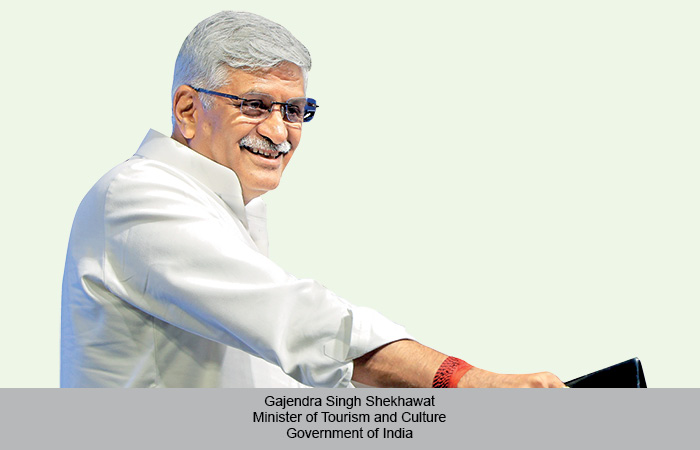
Gajendra Singh Shekhawat, Minister of Tourism and Culture, Govt of India, said that the country’s tourism sector is on the verge of a remarkable transformation, supported by infra growth, expanding domestic travel, and a strong focus on sustainability and investment.
Nisha Verma
Reminiscing about how strong inbound tourism was, Gajendra Singh Shekhawat, Minister of Tourism and Culture, Government of India, said that the focus of Indian hoteliers was to appear in international travel guidebooks to attract foreign guests. “Those days, inbound tourists were the best paymasters. The property whose name appeared in such guidebooks was considered secure. But today, none of the hotelier is dependent on that. Indians are better paymasters now,” he added.
He underlined, “Inbound tourism cannot be understood from the point of view of just numbers, nor can its possibilities be fully captured.” Referring to the transformation of destinations like Ayodhya, he said, “When Radisson started the hotel in Ayodhya, `1 lakh was the room tariff per night. No foreign tourists in the world will give you ` 1 lakh for a day at such a destination. Even now, they are charging `35,000, and still there are no rooms available.”
Travel demand fuelling economy
Shekhawat linked the growth in domestic tourism to India’s economic progress. “In the span of 10 years, we have grown from an economy of $2 trillion to $4.14 trillion. All analysts believe that India’s economy is growing at the fastest rate in the world. If it grows at this rate, it will double every 7–8 years. By 2047, the $4 trillion economy that we are talking about today will become a $30 trillion economy,” he shared.
He added that this economic momentum has given rise to a larger middle-income group. “Due to the precise power of implementation, 25–30 crore people have been able to get out of the poverty line and live the life of the middle class. The government has given tax rebates through the last budget — tax-free income of `12 lakh — which has increased disposable income and contributed to increasing tourism opportunities,” he said.
However, Shekhawat acknowledged that the supply of hospitality infrastructure has not kept pace with demand. “In the last 10 years, the way our demand has increased, the pace of supply is not up to the mark. Hence, there is mismatch of demand and supply,” he noted.
Infrastructure policy push for hospitality
Shekhawat revealed that they have taken steps to address the investment gap in hospitality. “We have created 50 iconic destinations, and apart from that, every destination with a population of less than 10 lakh has been granted infrastructure status. This will increase the flow of investment,” he said.
He pointed out that nearly 18 states have now given industry status to tourism and hospitality. The Ministry has also shared a draft of national tourism policy with all states. “We discussed the policies of all states that adopted the best practices, made a draft policy on that basis, and shared it on Tourism Day. We are working to give incentives to all states in the hospitality sector and for new hotel investments,” he added.
Shekhawat emphasised that sustainability must guide India’s tourism growth. He also identified wellness, medical, MICE and wedding tourism as emerging verticals. Addressing the industry, Shekhawat said the sector must collectively work. “We must discuss how we can reduce the cost of staying in our star hotels. If we don’t address the rate hike, it will become a big challenge for us,” he said.